
Vol. 13 No. 24 (2017): World Tensions

					View Vol. 13 No. 24 (2017): World Tensions
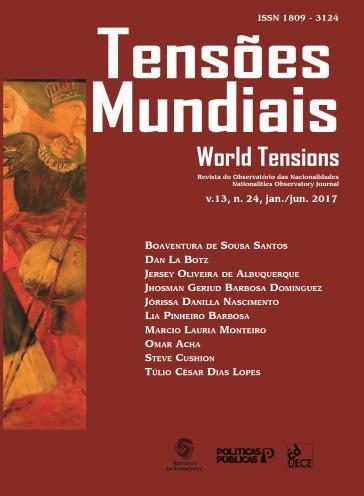
An outstanding feature of Frida Kahlo's work is introspection. Exploring physical and psychological traumas, Kahlo is persistent in self-portraits revealing her pain and anguish. The personal character of her production does not prevent it from being crossed by themes such as Mexican nationality, expressed in the use of typical costumes and in combining her image to the flora and fauna of her country. Frida and her husband, the muralist Diego Rivera, were leftist militants, and welcomed Trotsky and his wife when in search of exile in Mexico in 1937. Regarding the association of her work to surrealism, she adds: "I never painted dreams. What I showed was my reality."

Published: 2017-01-18

Editorial

  • Editorial

    Monica Dias Martins
    07 - 14
    DOI: https://doi.org/10.33956/tensoesmundiais.v13i24.437
  • Editorial

    Monica Dias Martins
    15 - 22
    DOI: https://doi.org/10.33956/tensoesmundiais.v13i24.440
  • Editorial

    Monica Dias Martins
    23 - 30
    DOI: https://doi.org/10.33956/tensoesmundiais.v13i24.439

Artigo

  • The place of the Russian Revolution in the revolutionary cycles in Latin America

    Omar Acha
    41 - 66
    DOI: https://doi.org/10.33956/tensoesmundiais.v13i24.359
  • The Communist International, the Soviet Union, and their impact on the Latin America Workers' Movement

    Dan La Botz
    67 - 106
    DOI: https://doi.org/10.33956/tensoesmundiais.v13i24.360
  • Legacy and ruptures of the Soviet Revolution from the social struggles in Latin America

    Lia Pinheiro Barbosa
    107 - 138
    DOI: https://doi.org/10.33956/tensoesmundiais.v13i24.361
  • Trotskyism and the 1952 Bolivian Revolution

    Marcio Lauria Monteiro
    139 - 166
    DOI: https://doi.org/10.33956/tensoesmundiais.v13i24.362
  • Party and revolution in Lenin, Gramsci e Mariátegui

    Túlio César Dias Lopes
    167 - 192
    DOI: https://doi.org/10.33956/tensoesmundiais.v13i24.363
  • The Russian Revolution impacts on J. C. Mariátegui's marxism

    JÓRISSA DANILLA NASCIMENTO AGUIAR
    193-212
    DOI: https://doi.org/10.33956/tensoesmundiais.v13i24.347
  • From the Russian Revolution to the Cuban Revolution

    Steve Cushion
    213 - 242
    DOI: https://doi.org/10.33956/tensoesmundiais.v13i24.364
  • The Socialist Transition: Reception and Development in the Cuban Socialism

    Jhosman Gerliud Barbosa Domínguez
    243 - 266
    DOI: https://doi.org/10.33956/tensoesmundiais.v13i24.365
  • The Revolution that "failed": common sense and 1917 impact in Brazil

    Jersey Oliveira de Albuquerque
    267 - 296
    DOI: https://doi.org/10.33956/tensoesmundiais.v13i24.366

Essays

  • El problema del pasado es que no pasa

    Boaventura de Sousa Santos
    33 - 37
    DOI: https://doi.org/10.33956/tensoesmundiais.v13i24.441

Book Reviews

  • Against a disjointed and weakened left

    Angícia Gomes Pereira Mourão
    299 - 304
    DOI: https://doi.org/10.33956/tensoesmundiais.v13i24.443
  • A Marxist Analysis of the Nicaragua Revolution?

    Graham E. L. Holton
    305 - 311
    DOI: https://doi.org/10.33956/tensoesmundiais.v13i24.445